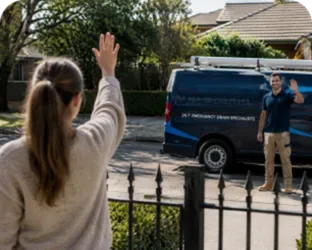
Repairs same day where we can. And on lots this tight we work out what will actually fit, legally and serviceably, before recommending you buy anything.
Online Now!·--:--
Most hot water advice starts with fuel. Gas or electric, storage or continuous, heat pump or not. That is the right question in a suburb with room to put things.
On a great deal of this housing it is the second question. The first is whether there is anywhere the unit can legally and safely sit. Frontages are narrow, a lot of the stock shares a wall, and the side passage where the old unit lives is frequently too tight to service properly, let alone to take something larger.
Add heritage conservation areas across much of the suburb, which constrain what can change on a street frontage, and the shortlist narrows before anyone has discussed running costs.
So we measure first. Clearances, ventilation, drainage, whether it is visible from the street, and whether the noise lands on a neighbour's bedroom wall. Then we tell you what your real options are, which is sometimes fewer than the brochure suggests.


The make, roughly how old, and whether it is in a side passage, a rear yard or inside. That usually tells us the answer before we arrive.
Every unit has minimum clearances for servicing and, if it burns gas, for ventilation and flue termination. Those are not optional and they are not negotiable at inspection time.
On a frontage of a few metres with a shared wall, the available envelope is often smaller than the unit somebody has already been sold. Measuring first is not caution, it is the difference between an installation and a return.
A storage tank takes up ground. On a lot where the only outdoor space is a side passage you also have to walk down, a tank can effectively close the passage.
A continuous flow unit hangs on a wall and gives that ground back, which on tight sites is frequently the deciding factor rather than the running cost. It does need gas that can supply it, which is worth checking before ordering.
A heat pump moves heat rather than making it, so it needs real airflow around it, and it runs a fan and a compressor to do that.
In a rear yard with a bit of room they are a genuinely good answer here. Wedged into a narrow side passage a metre from a window, less so, and if that window belongs to the neighbour you will hear about it. We will tell you plainly which situation you are in.
Heritage conservation areas cover a lot of this suburb, and they constrain external change on a street frontage. A like-for-like swap in the existing position is generally straightforward.
A new position that is visible from the street, or a flue or vent that changes the look of a period frontage, is a different matter and worth establishing before you commit rather than after the unit is on the truck.
In a conversion the plumbing was retrofitted to reach a connection point fixed long beforehand, so hot water often travels a long horizontal run to get to a tap.
That shows up as a long wait at the outlet and a lot of cold water down the drain, and replacing the unit does not fix it because the unit was never the cause. The fix is usually about where the heat is generated relative to where it is used.
Type and size decide most changeovers. Undersize a tank and you run out mid-shower. Oversize it and you pay to keep water hot that nobody uses. On these lots there is a third constraint before either of those: whether the thing physically goes anywhere.
| System | How it heats | Typical life | Suits a Marrickville lot when |
|---|---|---|---|
| Electric storage | An element heats a tank, often overnight on a controlled load tariff | 8 to 12 years | There is floor space for a tank and no gas at the property |
| Gas storage | A burner under a tank keeps a stored volume hot and ready | 8 to 12 years | There is room and ventilation for a tank plus its flue clearances |
| Continuous flow | Gas heats water on demand as it passes, nothing is stored | 15 to 20 years | Ground space is the constraint, because it hangs on a wall instead |
| Heat pump | Moves heat from the air into the tank rather than generating it | 10 to 15 years | There is a rear yard with real airflow and no bedroom wall beside it |
| Solar with boost | Roof collectors do the work, an element or burner covers the gap | 15 to 20 years | The roof is not heritage-constrained and the tank has somewhere to go |
A starting point rather than a rule. A household that showers back to back inside an hour needs more than the same number of people spread across a morning.
| People in the house | Electric storage | Gas storage | Continuous flow |
|---|---|---|---|
| 1 to 2 | 125 to 160 L | 90 to 135 L | 16 L/min |
| 3 to 4 | 250 to 315 L | 135 to 170 L | 20 L/min |
| 5 or more | 315 to 400 L | 170 to 200 L | 26 L/min |
Quoted at a fixed price before it starts. These are indicative 2026 ranges. Where the unit has to move position, the extra pipework and any flue work is priced separately so you can see exactly what the siting is costing you.
Element, thermostat, valve or anode. Frequently done in the same visit.
Like for like, installed and compliant, old unit taken away.
Wall hung, which gives the ground back. Subject to what the gas line supports.
Where there is genuine airflow and the noise does not land on a bedroom wall.
Extra pipework, and flue work where it applies. Always shown as its own line.
Hot water is the call we take most often, and these are the makes behind it.
We service and replace these systems as an independent licensed plumber. We are not an agent for, or endorsed by, any of these manufacturers.


Make, rough age and position. On these lots the position is half the diagnosis, because it decides what can replace it.

Plenty of failures are an element, a thermostat or an anode. We check before recommending you spend thousands.

If it does need replacing, we measure what will legally and serviceably fit in the space that actually exists.

Fitted to standard, tested, and the old unit removed rather than left down the side of the house.
Tell us the make, the rough age, and whether it sits in a side passage or a rear yard. On these lots that last answer changes the options more than the brand does.
Call 1300 381 569
If it is gas, check whether the pilot or ignition is still going and that the gas is on at the meter. If it is electric, check the switchboard, and check whether it is on a controlled load tariff that only heats overnight, because a unit that ran out at 7am has not necessarily failed. If it is a heat pump, listen for whether the fan is running at all. Then look underneath for water. A unit that is leaking is a different conversation from one that simply is not heating, and knowing which saves us both time.
Because on lots this narrow they usually are. A great deal of this housing sits on a frontage of a few metres with a shared wall down one side and little or no usable setback on the other. There is often no legal, ventilated, serviceable spot for a unit that is any bigger than the one already there. That is not a sales line. It is why we measure the space and check the clearances before recommending anything, rather than after.
Sometimes, and it is worth asking. The catch is that a heat pump needs genuine airflow around it and it makes noise while it runs. On a narrow lot the only available position is frequently a metre from a bedroom window, and quite often that bedroom is the neighbour's. Where there is a rear yard with a bit of room it can be an excellent answer. Where the only spot is a side passage nobody could walk down, it is not, and we will say so.
For a like-for-like replacement in the same position, usually not much. Where it starts to matter is if the new unit needs to go somewhere visible from the street, or needs a flue or a vent that changes the appearance of a frontage. Heritage conservation areas are widespread through this suburb and they constrain external change. It is worth establishing what is actually allowed before you commit to a system that has to go out the front.
Usually yes. Plumbing retrofitted into a building that was never designed for it tends to run long horizontal distances from wherever the connection point ended up, so the delay before hot water arrives at the tap can be substantial and has nothing to do with the unit itself. There is also often nothing below slab level, so the position options are whatever the original conversion allowed. Continuous flow is frequently the practical answer in that situation, though it depends on the gas supply.
Depends on the fault and the age. A failed element, a thermostat or a spent anode on a tank that is under ten years old is usually worth repairing and often can be done same day. A tank that is rusting through, or one already past about fifteen years, is throwing good money at a unit that will fail again. Where it matters here is that replacement may also reopen the siting question, so we work out what will actually fit before recommending it.
A repair, so an element, thermostat, valve or anode, generally runs $250 to $650. A like-for-like tank replacement in the same position is $1,400 to $2,800 installed. Continuous flow is $1,900 to $3,500 depending on the unit and what the gas line will support. Heat pumps sit higher again and are worth pricing against the rebates. Where the position has to move, that adds pipework and sometimes a flue, and we price that separately so you can see it.
Tell us what it is, roughly how old, and where it sits. On lots this tight the position decides as much as the fuel does, and it is better established now than on the day.
Repairs quoted before they start, and if it needs replacing we measure what will actually fit before recommending anything.
Online Now!·--:--